| |
Plasma Cutting Machines ,Micro Plasma Welding Machine-MP 25,Micro TIG Welding Machine-MT 50,Plasma Cutting Machine-ARC CUT 10i, Plasma Transferred Arc (PTA)-PTA 200, Plasma Welding Machine-PW 200, Plasma Welding Machine-PW 400, SAW Strip Cladding, ESSC-ESW Strip Cladding, HARD BANDER
|
| |
PRODUCTS |
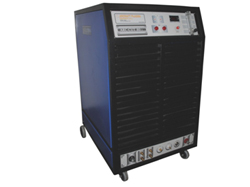
Plasma Cutting Machine (ARC CUT 40i)
|
|
Process:
• Plasma cutting is a process that is used to cut ferrous (stainless steel, cast iron, pig steel, etc.) and non-ferrous metal (aluminum, copper, tool steel, die steel, lead, nickel, tin, titanium and zinc, and alloys such as brass, etc.) using a plasma torch.
• In this process, air (for metal of 70mm and above inert gas) is blown at high speed out of a nozzle; at the same time an electrical arc is formed through that gas from the electrode to the surface being cut, turning some of that gas to plasma.
Features:
• IGBT inverter based with analog/digital controls & integrated HF arcing system that tremendously increases its efficiency and switching characteristic
• Ultimate Portability – Robust design with powder coated chassis & panel ensures long life in site conditions also
|
|
|
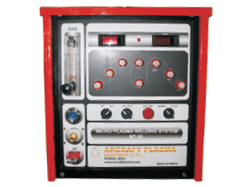
Micro Plasma Welding Machine MP-25
|
Process
• Plasma welding is very similar to TIG as the arc is formed between a pointed tungsten electrode and the work-piece.
• However, by positioning the electrode within the body of the torch, the plasma arc can be separated from the shielding gas envelope.
• Plasma is then forced through a fine-bore copper nozzle which constricts the arc. The micro-plasma arc can be operated at very low welding currents.
• Micro-plasma is traditionally used for welding thin sheets (down to 0.1 mm thickness), and wire and mesh sections, tubes and various delicate assemblies and parts with great precision and reliability
Features:
• IGBT inverter based with integrated HF start system. PLC sequencer for automatic operation and integration with welding lathe / positioner / turntable / linear welding fixture etc
• Wave Correction Technique - Milli second square wave correction technique for fast correction of welding current irrespective of arc length or input voltage variation
|
 |
|
|
|
Process
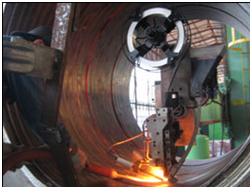
• Flux is used to form a molten slag to protect the weld pool from the atmosphere and helps to form a smooth weld bead surface.
• Highly alloyed materials, such as stain-less steel or nickel-base alloys, are needed in many applications to provide protection against corrosion.
• However, the comparatively high cost of these materials in many cases makes deposition of a protective layer on a less expensive load bearing mild or low alloy steel economically the most realistic alternative.
• Furthermore, weld surfacing with A6S SAW Strip Cladding head gives the designer and the fabricator a great degree of freedom providing the possibility to choose a wide variety of parent materials and consumables.
|
|
|
|
|
Process
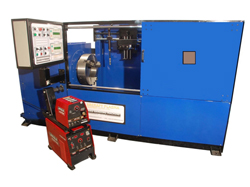
• Hardbanding is the process of depositing hardfacing alloys onto drill pipe tool joints, collars, heavy weight drill pipe and other down hole components to protect both casing and drill string assets from abrasive wear.
• Hardbanding is most commonly applied to the box end of drill pipe tool joints using a MIG welding process, bonding the hardbanding alloy with the parent steel of the drill pipe. There are, however, other hardbanding application methods that are occasionally used including laser and plasma arc processes
Features:
• Simplified Control Panel
• Automatic Step over system
• Program stop on number of bands
|
|
|
Plasma Transferred Arc (PTA)-PTA 200
|
|
| |
Top Features: |
Output Power: |
User Industries |
• High Quality Deposit
• Precise Coating
• Reduces Downtime
• Prolongs Equipment Life
|
|
• Current Range – 20 to 200 Amp |
|
• Typical application areas of the PTA technology are extruding machine screws, valves, valve seats, accessories for ships, petroleum chemistry and power generation, cutting tools, equipment for mining, crushing, rolling, road building and tunneling.
|
|
Process
• Plasma Transferred Arc is used for welding at high arc travel speeds.
• For initiating a transferred arc, a current limiting resistor is put in the circuit, which permits a flow of about 50 amps, between the nozzle and electrode and a pilot arc is established between the electrode and the nozzle.
Features:
• Reduces Cost - Restoring a worn part to "as new" condition generally costs between 20-70% of a brand new replacement part
• Prolongs Equipment Life - Service life increases of 3 to 10 times are common with properly overlaid parts
|
|
|
|
|
Process:
• Electro-Slag Strip Cladding (ESSC)/Electro-Slag Welding(ESW) is a development of submerged arc strip cladding which has quickly established itself as a reliable high deposition rate process.
• ESW strip cladding relates to the resistance welding processes and is based on the ohmic resistance heating of a molten electrically conductive slag.
• There is no arc between the strip electrode and the parent material. The heat generated by the molten slag melts the surface of the base material, and the edge of the strip electrode is submerged in the slag and flux.
Features:
• Increased Welding Speed - Increased welding speed (50%–200%), results in higher area coverage in m2/h
• Flux Consumption – Low
• Low Solidification Rate - Aids de-gassing and increases resistance to porosity. Oxides can rise easier out of the molten pool to the surface; resulting in a metallurgically leaner weld metal which is less sensitive to hot cracking and corrosion
|
|
|
Micro TIG Welding Machine (MT-25) |
|
Top Features:
• IGBT inverter based
• Wave Correction Technique
• Low Metal Thickness
• Pulsed current at high frequency
Output Power:
• Current Range – 1 to 25Amp
User Industries:
• It is used extensively in the manufacture of space vehicles, bicycle industry, in maintenance and repair work, for critical welding operations like sealing spent nuclear fuel canisters before burial
Process:
Gas Tungsten Arc Welding (GTAW), also known as Tungsten Inert Gas (TIG) welding, is an arc welding process that uses a non-consumable tungsten electrode to produce the weld. The weld area is protected from atmospheric contamination by an inert shielding gas (argon or helium), and a filler metal is normally used.
|
|
|
|
|
An inverter used in the welding application functions as below:
- AC Line voltage is taken as the input to the welding equipment.
- It is suitably RFI/EMI filtered and rectified.
- This rectified voltage is filtered to make it pure DC.
- This Dc voltage is taken as the input to the switching device through a high frequency power transformer.
- As this switching frequency is very high the size of this transformer becomes very small compared to its counter parts.
- The transformer output is suitably stepped down.
- This stepped down AC voltage is again rectified using fast recovery diodes.
- This output is used for welding.
- Suitable controls and feedback techniques are used
Features:
• Latest PWM technology using IGBTs.
• Standard inbuilt HF with fully fledged pulsing models.
• There is no surge of current, starts from the set value of current
|
|
|
| |
| Plasma Cutting Machine (ARC CUT 40i) | Micro Plasma Welding Machine MP-25 | SAW Strip Cladding | Hard Bander | Plasma Transferred Arc (PTA)-PTA 200 | ESSC/ESW Strip Cladding | Micro TIG Welding Machine (MT-25) | Welding Inverters |
| |
|





_Welding_Machine_PTA-200.jpg)